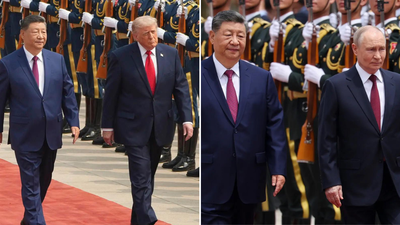
Within days of each other, Chinese President Xi Jinping rolled out the red carpet in Beijing for two of the world’s most powerful and controversial leaders: US President Donald Trump and Russian President Vladimir Putin. The near-identical military ceremonies, cannon salutes and choreographed welcomes were carefully designed to project China as the indispensable centre of global diplomacy.But beneath the pomp, the two visits revealed starkly different relationships. Trump arrived seeking stability after months of geopolitical turmoil and strained trade ties, while Putin came to reinforce a partnership that has become increasingly vital for a sanctions-hit Russia. Beijing treated both leaders with grandeur, yet the political messaging, diplomatic tone and strategic outcomes highlighted where China’s priorities truly lie.For Xi, the symbolism may have mattered most. Hosting Washington and Moscow back-to-back allowed the Chinese leader to present himself as a statesman capable of balancing rival powers while positioning China as an alternative pole to Western influence. At a time of wars in Ukraine and the Middle East, slowing economies and deepening distrust between global powers, Beijing appeared determined to show that every major geopolitical conversation now runs through China.
Two red carpets, two different messages
Trump and Putin both received lavish state welcomes outside the Great Hall of the People, complete with military honour guards, marching bands and children waving Chinese and foreign flags. The optics were strikingly similar, underlining China’s effort to appear equally open to both Washington and Moscow.Yet Beijing subtly differentiated the two visits. Trump was greeted at the airport by Vice-President Han Zheng, while Putin was received by foreign minister Wang Yi, a senior Communist Party figure and Politburo member. Analysts viewed the distinction as symbolic of China’s closer institutional trust with Russia.The contrast became clearer during meetings with Xi. Trump described Xi as a “great leader” and “friend”, but discussions between the two remained cautious. Xi warned that China and the US should be “partners and not rivals” and reportedly raised concerns over Taiwan and growing strategic tensions.
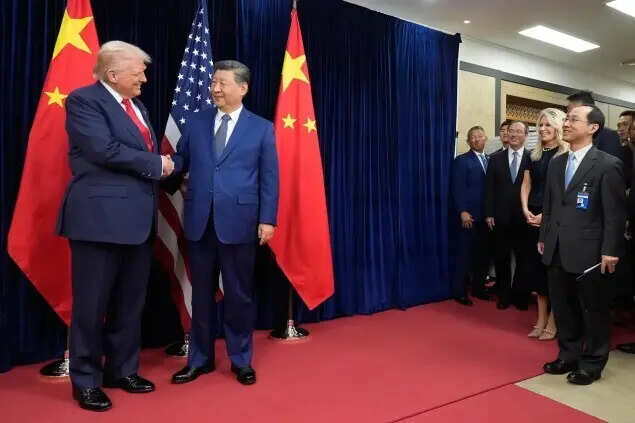
Putin, by contrast, was welcomed with far warmer rhetoric. Xi described China-Russia ties as “unyielding” and praised the relationship as a force of “calm amid chaos”. Putin responded by calling Xi a “dear friend” and using a Chinese idiom suggesting that “a day apart feels like three autumns”.
Trump sought stability, Putin sought survival
The two visits also exposed the differing needs of Washington and Moscow.Trump’s trip produced few immediate breakthroughs. Despite ceremonial banquets and lengthy talks, there was little progress on major disputes such as tariffs, semiconductor restrictions or China’s potential role in reopening the Strait of Hormuz amid the Iran crisis. The summit appeared focused more on preventing further deterioration in US-China relations than achieving concrete deals.Putin’s visit, however, carried far greater urgency. Russia’s economy continues to face severe strain from sanctions and the prolonged war in Ukraine. Moscow has increasingly turned towards Beijing as its primary economic lifeline, with China now Russia’s largest trading partner and biggest buyer of oil and gas.Energy cooperation dominated discussions. Russian officials pushed again for progress on the long-delayed Power of Siberia 2 gas pipeline, which would redirect supplies once intended for Europe towards China through Mongolia. Although no final agreement emerged, both sides signalled continued negotiations.The two countries signed around 20 agreements covering trade, technology, artificial intelligence, transport and agriculture. China also agreed to extend visa-free travel arrangements for Russian citizens until 2027. In contrast to Trump’s largely symbolic visit, Putin’s summit reinforced the practical foundations of a relationship increasingly built on mutual dependence.Still, the imbalance in that partnership is becoming harder to ignore. Russia now relies heavily on Chinese markets, technology and financial networks, giving Beijing significant leverage. Analysts noted that while Moscow still portrays the relationship as one between equals, China increasingly holds the stronger hand.
Xi’s diplomatic balancing act
For Xi, the back-to-back visits represented both a diplomatic triumph and a strategic challenge.The Chinese leader has spent years trying to reposition China from an isolated post-pandemic power into the centre of global diplomacy. Welcoming Trump and Putin within days allowed Beijing to showcase itself as a nation capable of engaging simultaneously with competing global powers.At the same time, the contrasting approaches to global conflicts exposed the limits of China’s balancing act. Xi openly called for an end to the war involving Iran and warned about disruptions to global energy supplies, yet remained noticeably silent on Russia’s invasion of Ukraine.China and Russia also used Putin’s visit to jointly criticise the United States, including Trump’s proposed “Golden Dome” missile defence system, which both sides said threatened global strategic stability.European governments are likely to watch these developments carefully. Beijing continues to portray itself as neutral on Ukraine, but its growing closeness with Moscow risks undermining attempts to rebuild trust with Western partners.Even so, the past week marked a powerful propaganda victory for Xi. With Trump and Putin both travelling to Beijing during moments of geopolitical weakness, China’s leader succeeded in projecting himself as the steady figure at the centre of an increasingly fractured world order.