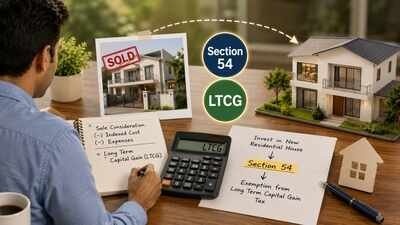
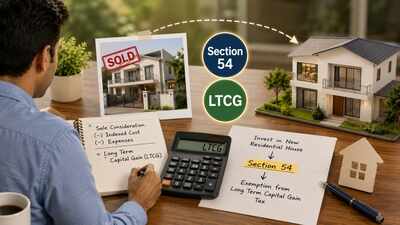
You bought a property jointly in the name of yourself and your wife, but the entire money spent on the purchase came from you. Now you are planning to sell it and are wondering whether the new property that you plan to purchase for long-term capital gains (LTCG) exemption, should also be jointly owned by you and your spouse or if your sole ownership also works.It’s an interesting question, and one that has income tax implications, so you need to be careful.The most important point to note in this matter is the proof of the financing for the first property. If you have a clear trail and adequate documentation that can establish the money to buy the first property was entirely yours, then the new property need not be purchased in joint names.
Joint property sale & LTCG exemption
Shubham Agrawal, Senior Taxation Adviser, TaxFile.in recently told ET that if an individual alone financed the entire joint property purchase, then he would be considered the 100% beneficial owner. In that case, the next property purchased through reinvestment can be registered solely in his name.She also listed some important points that the property owner should take note of when selling and claiming LTCG exemption benefits:
- When the jointly owned property is sold, make sure the buyer deducts the full TDS against your PAN alone.
- You should also report the entire sale proceeds and the resulting capital gain in your income tax return.
- It would be prudent to keep proper documentary proof of the payments made for the original purchase, as this can help establish that the entire investment was funded by you.
- The property sale may nevertheless appear in your wife’s AIS on the income tax portal because property sale information is sourced from the sub-registrar.
- In that situation, she should provide feedback on the portal stating that the transaction relates to another PAN or family member. This should largely help prevent her from receiving a notice for failing to report the income.
What is Section 54 to save tax on long-term gains from selling a house?
Section 54 provides relief from long-term capital gains tax when an individual or HUF sells a residential house and reinvests the capital gain in another residential house in India. This exemption has been made available so that if you are shifting from one home to another, then you should not face a tax burden only because the old property was sold to finance the new one.Let’s take a look at some important points about the exemption and its limits:1. Who can claim the exemptionThis Section 54 benefit is available only to an individual or HUF. Also, the property that is sold must be a long-term capital asset and a residential house property.Also, note that for immovable property, the holding period to qualify for the Section 54 exemption as long-term is 24 months. Therefore, if a house is sold before completing 24 months of ownership, Section 54 exemption benefits cannot be claimed.For example: If you bought a house in April 2024 and sold it in April 2025, since the property was held for less than 24 months, the gain is short-term and Section 54 does not apply.2. The replacement house must meet a time limitThe taxpayer can purchase another residential house within one year before or two years after selling the old property. Alternatively, a new house can be constructed within three years from the date of transfer. The replacement property must be in India.Importantly, a house purchased before the sale can also qualify, provided it was bought within the one-year window. For example, a house purchased in December 2024 can qualify against a residential property sold in April 2025.3. How much exemption can you actually getThe exemption is restricted to the lower of the capital gain or the amount invested in the new residential house. So, if the capital gain is Rs 1 lakh but only Rs 80,000 is invested in the new property, the exemption will be Rs 80,000 and Rs 20,000 will remain taxable. If Rs 1.2 lakh is invested against a Rs 1 lakh capital gain, the entire Rs 1 lakh gain can be exempt.There is also a special provision allowing investment in two residential houses, but only where the long-term capital gain does not exceed Rs 2 crore. This option can be exercised only once by the taxpayer.4. There is a Rs 10 crore ceilingThe exemption is not unlimited. From Assessment Year 2024-25, where the cost of the new residential property is more than Rs 10 crore, the excess is ignored while calculating the Section 54 exemption.So, for example if the capital gain is Rs 13 crore and you buy a new house for Rs 14 crore, only Rs 10 crore can qualify for the LTCG exemption. The remaining Rs 3 crore of capital gain remains taxable.5. What if you have not bought the new house by the ITR deadlineIf the capital gain has not been used to purchase or construct the new house by the time the income-tax return is filed, the unutilised amount can be deposited into the Capital Gains Deposit Account Scheme. This allows the taxpayer to claim the exemption while getting additional time to purchase or construct the replacement property. The deposited money must subsequently be used for that purpose.There is a crucial deadline here. The required deposit must be made by the due date for filing the return. A late deposit does not qualify for the exemption.6. The tax benefit can be lost laterSection 54 comes with a lock-in condition. If the new house is sold within three years of purchase or completion, the earlier exemption is effectively withdrawn. The amount of capital gain that was exempt is deducted from the cost of the new house when calculating its capital gain.Similarly, money placed in the Capital Gains Account must ultimately be used to buy or construct the house. If it remains unused after the permitted period, the exemption is withdrawn and the unutilised amount becomes taxable as long-term capital gains.