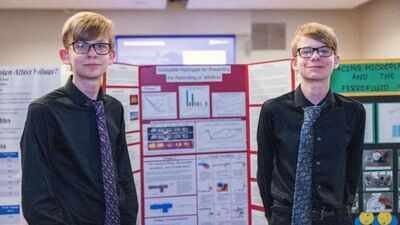
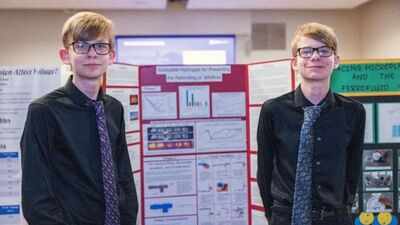
When Henry and Jack Grover nearly lost their Riverside, California, home to a wildfire, the experience changed the way they thought about fire safety. The identical twins wanted to understand why areas that appear extinguished can still contain hot, smouldering material capable of reigniting days later. Their answer was a sprayable hydrogel designed to hold water against hot surfaces for longer than water alone. According to the Society for Science, the twins’ hydrogel-treated charcoal took 27 minutes to reignite, compared with just three minutes for charcoal sprayed with water. The Riverside Unified School District says their project earned them a place among the 2026 Thermo Fisher Scientific Junior Innovators Challenge’s Top 30 finalists. Read on to know more about their innovation here:
A wildfire close to home
For Henry and Jack, the project began with a frightening personal experience. The twins nearly lost their home during a wildfire, giving them a direct understanding of how quickly flames can threaten families, neighbourhoods and natural habitats. Their concern deepened when they learned that a wildfire can sometimes be connected to an earlier blaze. The Society for Science profile notes that the 2025 Palisades fire was linked to the Lachman fire, which continued smouldering and reignited six days later.That detail made the twins focus on what happens after firefighters appear to have put out a fire. Burned areas can contain hot charcoal, roots, wood and other materials that remain capable of catching fire again. Water may cool the surface temporarily, but it can evaporate or run off before the material has cooled completely. “We knew that hydrogel was capable of absorbing hundreds of times its weight in water and releasing it over a short period of time, so we wanted to use it to prevent rekindling,” Henry said in his finalist profile on Society for Science.
Testing nine different hydrogels
Henry and Jack began by comparing nine hydrogels. Their aim was to find a material that could absorb a large amount of water, remain on a surface and release moisture gradually under high heat. They soaked the gels in water, weighed them and then placed them in an oven to dry. The twins measured the samples every 15 minutes to track how quickly the materials lost moisture. This helped them understand which hydrogels could retain water for longer when exposed to heat.The researchers also tested how well each gel adhered to a surface. They spread the materials on leaves, hung the leaves vertically and measured how much gel fell away. This step was important because a wildfire prevention spray would need to remain attached to leaves, branches, soil or burned material instead of sliding off immediately. After comparing water retention and adhesion, the twins narrowed their options to two leading candidates. They then measured how quickly each one hydrated, placing the materials in water and weighing them for up to three hours.
Sodium polyacrylate became the top choice
Their strongest-performing material was sodium polyacrylate, a hydrogel that fully hydrated in about 15 minutes. Once mixed with water, it could hold moisture and form a substance that stayed in place more effectively than water alone.The twins next tested the gel on hot charcoal briquettes. Charcoal provided a controlled way to study whether a hot material could reignite after treatment. They compared briquettes sprayed with plain water against briquettes treated with the hydrogel.The difference was significant. Charcoal sprayed with water reignited after approximately three minutes. The charcoal treated with their hydrogel took 27 minutes to reignite. That is nine times longer than the water-only result, giving firefighters more time for hot material to cool before it could produce another flame.The result does not mean the gel can prevent every wildfire from restarting. Real fires involve changing wind, uneven terrain, vegetation, embers and many kinds of burning material. However, the experiment showed why a substance that holds water in place could be useful in managing hot spots after a fire has been extinguished.
Designing a practical sprayer
The project did not stop with testing the material. Henry and Jack also wanted to show that the hydrogel could be delivered over a useful distance. Using a 3D printer, they designed a sprayer capable of applying the mixture more than 18 metres away. The Riverside Unified School District reported that the device worked with a garden hose, while the Society for Science recorded a spraying distance of 18.3 metres.A long-range sprayer could be useful in situations where people need to treat hot areas without walking directly across unstable or dangerous ground. It could also allow crews to apply the gel to sections of burned vegetation, piles of debris or other locations where water might disappear too quickly.Before such a device could be used by firefighting agencies, it would require extensive testing. Researchers would need to study how the hydrogel behaves in forests, grasslands and residential areas, as well as its effects on soil, plants, waterways and wildlife. The environmental impact of the material would be especially important because wildfire prevention treatments can spread beyond the original application area.
A project shaped by environmental concerns
Jack said the twins were also concerned about the ingredients used in some fire retardants. Traditional fire retardants can contain substances that may harm waterways and ecosystems if they are washed into the environment. “Knowing the harmful materials being dumped into our waterways and forests and residences, we wanted to make a more environmentally friendly fire retardant using a more biodegradable material, hydrogel,” Jack said in his Society for Science profile.Their work is therefore focused on more than extending the time before charcoal reignites. It also explores whether wildfire management can become safer for people and less damaging to the surrounding environment.The twins’ project shows how a personal experience can lead to a practical scientific question. Rather than simply asking how to put out flames, they examined the difficult period after a fire appears to be over. Their research focused on the hidden heat that can remain beneath the surface and the possibility of keeping that heat from becoming a new fire.
From Riverside to a national competition
Henry and Jack were named among the 30 finalists in the 2026 Thermo Fisher Scientific Junior Innovators Challenge. They were selected from 1,997 applicants representing 47 states, Washington, D.C. and five U.S. territories, according to Riverside Unified School District.The finalists are scheduled to travel to Washington, D.C., from October 23 to 28 for Finals Week. During the competition, they will be judged not only on their research but also on communication, collaboration, creativity and critical thinking. More than $100,000 in awards is available, including a top prize of $25,000.Outside the wildfire project, the twins share an interest in restoring old technology. Henry has worked on a robot from the 1980s, while Jack also enjoys robotics, old cameras and amateur archaeology. Their hobbies reflect the same curiosity that shaped their hydrogel research: take something apart, understand how it works and imagine how it could work better.For Henry and Jack, the hydrogel is still a project in development rather than a finished firefighting product. Yet their findings offer a promising starting point. By keeping hot charcoal from reigniting for 27 minutes instead of three, the twins have shown how a simple idea involving water, gel and careful testing could contribute to a safer response after wildfires.