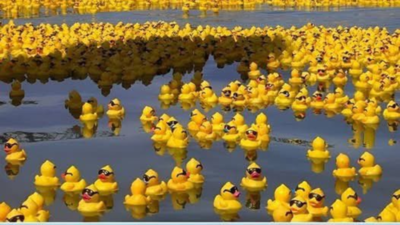
Shipping accidents happen every other day among the vast waves of the seas. While some leave cargo worth looting, others sink deep enough to make history. But one ship accident in 1992, left thousands of unsinkable toys swimming across the waters all over the globe. On January 10, 1992, 12 shipping containers from the cargo vessel Ever Laurel fell overboard during a storm in the North Pacific and one of them, carrying plastic toys including yellow ducks, blue turtles, red beavers and green frogs left them scattered across the ocean.The toys had been manufactured in China for the American company The First Years and these toys were designed without holes, letting them float on the currents until they reached dry land.The ship had been travelling from Hong Kong to Tacoma, Washington. During severe weather near the International Date Line, powerful waves swept 12 containers overboard. They first washed ashore on beaches in Alaska, near the town of Sitka, about 2,000 miles from where they fell into the water. What initially seemed like an amusing accident became the starting point for a scientific investigation.Two oceanographers Curtis Ebbesmeyer and James Ingraham saw the appearance of toys as an opportunity to study how ocean currents behave. Ocean currents are not easy to track. At the time, one common method was to release up to a thousand message-containing bottles and hope some would eventually be recovered. Only about 2% typically were.Although researchers had previously released tracking devices into the sea, this time there were thousands of floating toys that had all entered the water at the same place and time. Ebbesmeyer began collecting information about where and when the toys were found, with help from beachcombers searching for objects washed ashore by the sea. Ingraham, meanwhile, was working with a computer model called OSCURS, which simulated the movement of surface currents. They even offered $100 to anyone who reported a rubber ducky sighting.The researchers proposed that the toys had travelled through the Arctic and became trapped in the sea ice, the layer of ice floating on the world’s northernmost ocean. They moved at a rate of only a few kilometres per day, frozen in the ice blocks. They remained there until they were eventually released into the North Atlantic.The investigation produced several findings. First, some toys had travelled thousands of miles, while others had remained trapped in major ocean currents for years. The toys turned up in places including Hawaii, the US Atlantic coast, the United Kingdom, Ireland and eastern Canada.A father-son duo, Dean Orbison and his son Tyler, also began keeping a systematic record while working along the shorelines near Sitka. Starting in 1993, they recorded the date and location of toys they found and continued the effort for more than a decade.Researchers also conducted a simulated experiment, releasing 70 toys into the model at the exact time and location of the original accident. They then tracked the virtual toys day by day for 11 and a half years, from January 10, 1992, to July 19, 2003. The simulated toys remained relatively close together during their initial journey toward Sitka, Alaska. Researchers could then compare the model’s predictions with the actual toys that had been recovered from the shoreline. This comparison gave scientists a rare way to test how accurately the model represented the movement of floating objects. Researchers estimated that the toys could complete a circuit of the gyre in about three years.More importantly, the spill helped scientists design and feed real-world data into ocean current simulation models. Scientists were able to understand with unprecedented precision how long it took water to make a full circuit of the Pacific Ocean gyres and how microplastics and marine debris move around the planet. The spill demonstrated that ocean currents are not isolated systems. Instead, they form a vast network connecting distant regions of the planet.According to a report of the Science Blog, at Sitka’s beachcomber fair in July 2004, they displayed 111 toys collected between 1993 and 2004. By 2005, their total had reached 124. The recovered toys included all four types: 35 per cent ducks, 26 per cent beavers, 21 per cent frogs and 18 per cent turtles.Nowadays, although most of the toys have already degraded or broken down into microplastics due to solar radiation and wave action, the study of their dispersal is still used as the perfect example of how the interconnection of all the Earth’s oceans works. Some still occasionally turn up on beaches and sell online for as high as $1000.