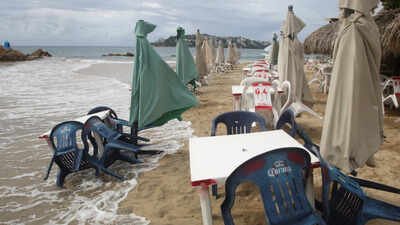
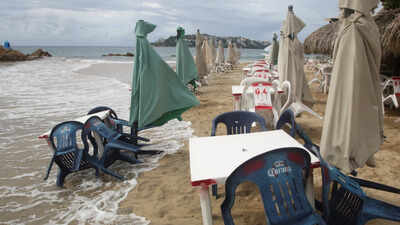
Powerful Hurricane Polo battered Mexico’s Pacific coast with heavy rain and flooding on Thursday, while Tropical Storm Nolo strengthened south of Hawaii and threatened to bring potentially dangerous rainfall, flooding and landslides to the islands.The US National Hurricane Center warned that Polo could trigger life-threatening flooding and landslides along Mexico’s western coast. In the port city of Lazaro Cardenas, seawater swept into homes, leaving furniture and wooden debris scattered across streets.Mexican authorities opened shelters, evacuated residents from vulnerable areas and deployed 15,000 security personnel along the coast as Polo moved offshore.Meanwhile, Nolo was gaining strength south of Hawaii’s Big Island, with forecasters expecting the storm to become a hurricane. Heavy rain was forecast to begin affecting Hawaii on Thursday, with hurricane-force winds possible by early Saturday.
Polo brings flooding threat to Mexico
Polo has fluctuated between Category 4 and Category 5 strength, both classified as major hurricanes. Its strongest winds were expected to remain offshore as the centre of the storm passed near Mexico’s Pacific coast before moving back out to sea.The hurricane centre warned that Guerrero and Michoacan faced the greatest risk, particularly rural and mountainous areas where flooding and mudslides could become dangerous.Tropical-storm-force winds extended up to 125 miles (201 kilometres) from Polo’s centre. Although the storm was expected to move away from land, forecasters said it could turn back toward Mexico’s coast farther north on Saturday.Authorities suspended schools as a precaution and moved residents from high-risk areas to shelters. The number of people evacuated was not immediately available.The storm brought back memories of previous hurricanes that devastated Mexico’s Pacific coast, including Hurricane Otis, which struck Acapulco in 2023 and left the city severely damaged.“So many people said it wouldn’t happen and then it did. After that, you’re left on edge,” said Gonzalo Ramírez, a bartender in the city.
Hawaii braces for Nolo
Far south of Hawaii’s Big Island, Tropical Storm Nolo was strengthening and could become a hurricane as early as Friday.Forecasters warned that Nolo could bring more than 2 feet (60 centimetres) of rain to parts of Hawaii. The Big Island was expected to receive the heaviest rainfall, with forecasts indicating up to 20 inches (50 centimetres) in some areas and potentially higher totals through Saturday.Maui was also at risk of life-threatening flooding and mudslides.John Bravender, warning coordination meteorologist with the National Weather Service in Honolulu, said the storm’s exact path remained uncertain but expressed concern about the southeastern Big Island, where the ground remained saturated following recent storms.“There are several communities that were isolated, flooded, roads that were washed out,” he said. “It’s that same area that is most under threat,” Bravender said.Bravender said the frequency of storms affecting Hawaii this year was unusual.“In my 20 years of experience here, I’ve never seen three hurricane watches for the islands in the same year,” said John Bravender of the National Weather Service in Honolulu.Hawaii has already faced major flooding, an earthquake and two hurricanes since mid-August.
Hawaii activates emergency measures
Hawaii Governor Josh Green issued an emergency proclamation as officials prepared for Nolo. More than 230 Hawaii National Guard members were activated, while schools were closed for the remainder of the week.Officials urged residents to prepare emergency kits and make arrangements for possible flooding and disruptions.Hawaiian Electric said crews that had been helping restore electricity on Kauai following Hurricane Lowell would return to Oahu, Maui and the Big Island ahead of Nolo.
El Niño linked to Pacific storm activity
The series of storms comes as El Niño drives changes in weather patterns across the world. The climate phenomenon can contribute to drought in some regions while increasing rainfall and flooding in others.El Niño typically suppresses Atlantic hurricane activity but can increase tropical cyclone activity in the Pacific by creating conditions with more moisture and less wind shear.
Two other storms remain away from land
Hurricane Odalys, another Pacific storm, was located about 1,110 miles (1,785 kilometres) west-southwest of the southern tip of Mexico’s Baja California peninsula and posed no immediate threat to land.In the northern Atlantic, Tropical Storm Fay re-formed early Thursday, according to the US hurricane centre. It was located nearly 1,000 miles (1,600 kilometres) west-southwest of the Azores.