
‘Nirantar’ Nitish turns a new page, set for Rajya Sabha after decades as Bihar CM | India News
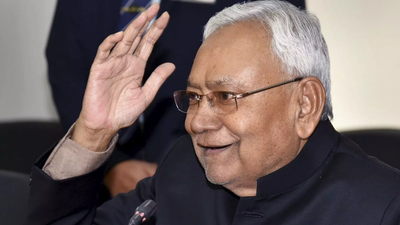
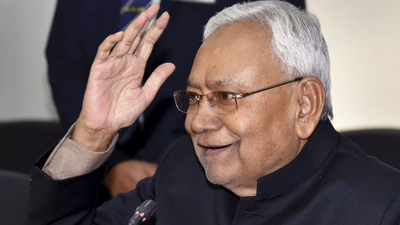
NEW DELHI: Just four months after leading the NDA to a sweeping victory in the Bihar elections, chief minister Nitish Kumar has once again rewritten his political script.The veteran leader on Thursday announced his decision to step down from the state’s top job and head to the Rajya Sabha, marking a significant transition for a politician who has dominated Bihar’s politics for most of the past two decades.Nitish said he had long harboured a desire to become a member of both Houses of the Bihar Legislative Assembly as well as both Houses of Parliament.“For more than two decades, you have consistently placed your trust and support in me, and it is on the strength of that trust that we have served Bihar and all of you with complete dedication,” he said on his social media account.“It was the power of your faith and support that has enabled Bihar today to present a new dimension of development and dignity. For this, I have expressed my gratitude to you on several occasions in the past as well.”The decision comes less than four months after Nitish led the NDA to a sweeping victory in the 2025 Bihar Legislative Assembly election, securing a massive majority of 202 seats. On November 20, 2025, he took oath for a record tenth term as chief minister, a milestone that reaffirmed his hold over the state’s politics.
At 75, he now steps away from the chief minister’s chair after what many saw as an emphatic electoral endorsement. His move to the Rajya Sabha is expected once the new term begins after April 9, when outgoing members retire.Within the NDA, the transition is being seen as a carefully timed change of guard that could allow a new leadership team to settle in before the next political cycle. With Nitish shifting to Parliament, the door is open for the Bharatiya Janata Party to appoint its own chief minister in Bihar for the first time.Potential successors include Bihar deputy chief minister Samrat Choudhary and Union minister Nityanand Rai, both seen as strong contenders if the BJP takes over the top post.At the same time, speculation has grown over the possible political debut of Nitish’s son, Nishant Kumar. Some within the alliance believe he could be considered for a deputy chief minister’s role, though there is no clarity yet about his position or responsibilities.
The ‘nirantar’ Nitish
For years, Nitish Kumar has remained the central figure in Bihar’s politics- a leader who repeatedly returns to the top despite doubts, criticism and shifting alliances.His image as “Sushasan Babu,” associated with development, stability and restored law and order, has long shaped his political identity, even as critics argued that policy stagnation and political fatigue had begun to dull that sheen.Yet in 2025, the verdict was emphatic.Despite being written off many times, Nitish once again emerged victorious with what supporters described as a “lion majority”, reaffirming his place at the centre of the state’s politics.
From engineer to political strategist
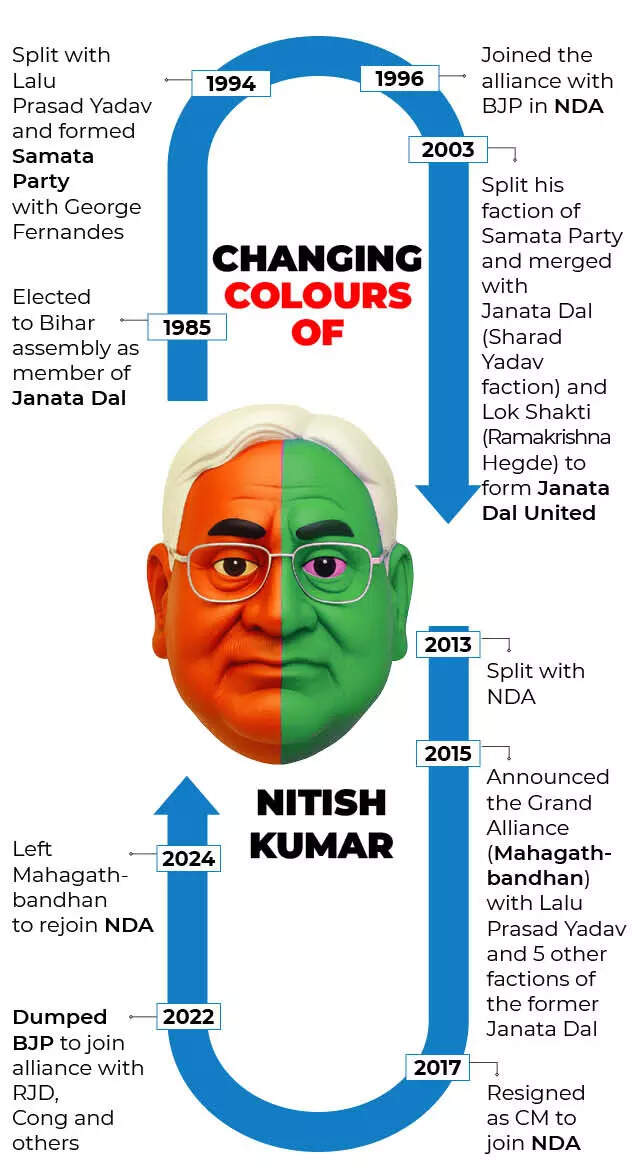
Born on March 1, 1951, in Bakhtiarpur, Nitish Kumar did not begin with political ambition. Trained as an electrical engineer, he eventually found his calling in public life.His political roots were shaped during the Emergency in India imposed during the era of Indira Gandhi. As part of the movement led by Jayaprakash Narayan, Nitish was among the thousands jailed during that period.He won his first assembly election in 1985 from Harnaut and briefly supported Lalu Prasad Yadav in 1989 before breaking away, beginning a rivalry that would define Bihar politics for decades.In 1994 came a decisive turning point. Fourteen MPs broke away under George Fernandes in the first major rebellion against Lalu. Insiders widely saw Nitish as the strategist behind the move.The group soon formed the Samata Party, marking a decisive shift in his political trajectory.Two years later, Nitish made another major move by aligning with the BJP in 1996, the beginning of a partnership that would form, break and reform repeatedly over the next three decades.He later entered the cabinet of Atal Bihari Vajpayee, holding the railway ministry and other portfolios between 1998 and 2004. His administrative approach and emphasis on law and order gradually helped build his technocratic image.His first attempt at becoming chief minister came in 2000, but the NDA lacked numbers and his government fell in just seven days.
Era that shaped Bihar
In 2005, Nitish returned to power, ending Lalu Prasad Yadav’s 15-year rule- a period often described by critics as “jungle raj”.His victory in 2010 further consolidated his political dominance and established him as the face of development-oriented politics in the state.Women-centred welfare initiatives including bicycles, uniforms, prohibition, jobs and cash transfers became a major pillar of his governance model, creating what some scholars describe as a maternal welfare state.Yet Nitish Kumar’s political career has been defined not only by governance but also by dramatic shifts in alliances.Since 1999, he has switched between the National Democratic Alliance and opposition formations such as the UPA or Mahagathbandhan multiple times.The frequent realignments earned him the nickname “Paltu Kumar”.Now, with his move to the Rajya Sabha, another chapter in that long and unpredictable political journey begins.