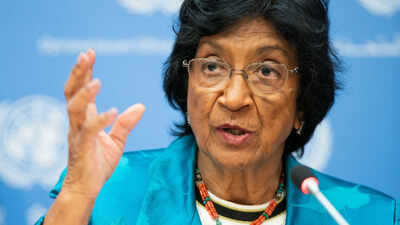
Navanethem “Navi” Pillay, a South African jurist of Indian Tamil origin, has been awarded the 2026 Nobel Peace Prize for her efforts to promote peace and international law. Her recognition honours a career spanning decades in which she challenged racial discrimination, defended human rights and helped strengthen international legal institutions.Born into a Tamil family in Durban under South Africa’s apartheid regime, Pillay experienced racial discrimination first-hand before becoming a lawyer who defended anti-apartheid activists. Her work subsequently took her to some of the world’s most important judicial institutions, including the International Criminal Tribunal for Rwanda (ICTR), the International Criminal Court (ICC) and the United Nations.The Norwegian Nobel Committee highlighted her commitment to universal legal principles and her firm moral compass. Pillay played a significant role in landmark international legal proceedings, particularly in establishing that rape and sexual violence could constitute acts of genocide. She also served as the UN High Commissioner for Human Rights and chaired the UN Independent International Commission of Inquiry on the Occupied Palestinian Territory. She is currently a judge at the International Court of Justice (ICJ) in the case in which Myanmar faces allegations of genocide.
Who is Navi Pillay ?
Navanethem Pillay was born on September 23, 1941, in Clairwood, Durban, in South Africa’s then Natal province. Her father was a bus driver, and she grew up in a family of eight children during apartheid, when racial segregation severely restricted opportunities for Black South Africans and other non-white communities.Pillay studied at the University of Natal, earning a bachelor’s degree in 1963 and a law degree in 1965. In 1967, she became the first woman to establish her own law practice in Natal, representing political activists detained by the apartheid government. She later pursued postgraduate studies at Harvard University, earning a Master of Laws in 1982 and a Doctor of Juridical Science in 1988.Her career subsequently expanded from defending activists in South Africa to shaping international law. As a judge at the Rwanda tribunal, she helped establish important legal precedents on sexual violence during genocide. She later served as a judge at the ICC and as the UN High Commissioner for Human Rights from 2008 to 2014.Navi Pillay: Key facts
- Early life: Born on September 23, 1941, in Durban, South Africa, to a family of Indian Tamil origin.
- Legal pioneer: Became the first woman to establish a law practice in Natal in 1967 and defended anti-apartheid activists.
- Education: Earned law degrees from the University of Natal and postgraduate qualifications from Harvard University.
- Rwanda tribunal: Served as a judge at the ICTR from 1995 and became its president in 1999.
- Landmark ruling: Helped advance the recognition of rape as an act of genocide in the trial of Jean-Paul Akayesu.
- International Criminal Court: Served as an appeals judge at the ICC from 2003 to 2008.
- UN human rights chief: Held the position of UN High Commissioner for Human Rights from 2008 to 2014.
- Women’s rights: Co-founded Equality Now, an international organisation working to advance women’s rights.
- Constitutional reform: Contributed to efforts to secure equality protections in South Africa’s post-apartheid Constitution.
- Nobel recognition: Received the 2026 Nobel Peace Prize for her efforts to promote peace and international law.