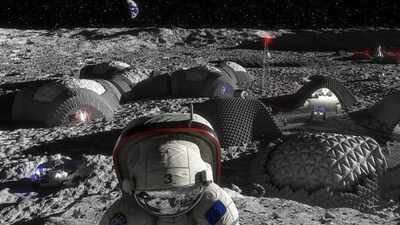
A city on the Moon that grows by itself, produces its own resources, and eventually houses millions of people: this idea sounds like pure science fiction, but then again, so did reusable orbital rockets not long ago. In early 2026, according to Reuters, Musk told the world that SpaceX was shifting its eyes toward the Moon and that a self-building lunar metropolis could be on the horizon within a decade.That dream just hit a big obstacle. And it’s not money, launch costs, or robots. It’s water.A new study by scientists Martin Elvis and Jonathan McDowell looked at how much water might actually be up there. Even if they use the most generous estimate for the Moon’s water, it’s still not nearly enough for a million humans to drink, farm, clean, and generally survive on indefinitely.Their research, published in Frontiers in Space Technologies, suggests that, even recycling water as efficiently as the International Space Station does, a million-lunar-citizen city could blow through its supply in just over a century. If the real amount of water on the Moon is lower (and honestly, right now, most scientists think it is), that timeline shrinks fast; maybe all the way down to a decade.So does this mean lunar living is toast? Not exactly. Elvis and McDowell’s numbers don’t rule out smaller settlements: a base, a station, maybe even a little town. It just puts a hard limit on Musk’s dream of millions of people starting new lives up there and watching their city grow bigger every year.
Why water is everything on the Moon
Out in space, water isn’t just something you stash in your fridge. On the Moon, it’s life. And fuel. And food. And, possibly, the key to ever getting any kind of real city there. NASA’s satellites have found water ice in shadowed craters near the lunar poles, places so cold and dark that water has likely been frozen there for billions of years. There’s some water elsewhere on the surface too, but not nearly as much.Astronauts will want to drink some of it. They’ll want to grow plants. But if you split the water, you can make oxygen to breathe and hydrogen to power rockets, which is huge if you’re trying to launch return trips or expand further into space.That makes water one of the most important resources for any Moon settlement. The trouble is, no one knows exactly how much is there or how easy it would be to dig up.
How much water are we talking?
Elvis and McDowell started with a best-case scenario: about one billion tonnes of lunar water. That’s a lot, until you think about what a city of a million humans uses up. With near-perfect recycling (like the ISS manages), you get just over a hundred years before all the Moon’s water runs out. No recycling? You’d drain the place in only a few years.The grim part: most scientists think the Moon has far less than a billion tonnes, maybe 30 times less. If that’s true, you don’t get a century; you get a few years. You’re not building a self-growing city; you’re building a tent and hoping for rain.But if your settlement’s smaller (think a thousand people, or even ten thousand), it suddenly gets more manageable. At that scale, you might be able to stick around for centuries or longer.
Will the Moon actually ‘run dry’?
When the Moon runs out of water depends on a few things: how much ice is really tucked in those craters, how efficiently settlers recycle their water, and how much they use for farming, cleaning, industry, and basic life.Those numbers shift all over the place. If you somehow get a city of a million people and 98% recycling, maybe you get a bit over a century before things dry up. If the less hopeful water estimates are the real deal, you could run out in a decade, even with fewer people.That’s why more Moon exploration isn’t just a good idea; it’s essential before making serious colonization plans.
Water might be even harder to get than it sounds
It’s easy to say, “there’s lunar ice — problem solved!” The reality is a lot messier. Most of that ice is buried at the bottom of permanently shadowed craters in rough, cold, dangerous terrain. Scientists still don’t know exactly how much water there is, how deep it’s buried, or how hard extraction might be.NASA is still mapping and studying this question. They’re trying to figure out where the ice is, what state it’s in, and whether it’s accessible with existing or future tech.
Could tech change the equation?
Elvis and McDowell aren’t writing off the Moon just yet. Maybe recycling will get way better: closer to 99% or above. Maybe vertical farms will use less water. Or maybe we’ll just bring in ice from asteroids, one shipment at a time. It’s also possible, although unproven, that there’s a hidden water jackpot deeper under the lunar surface. Most surveys only check a few meters down. The regolith (the dusty lunar “soil”) can be dozens of meters thick. Who knows what sits below that?Interestingly, power isn’t as limiting as water. Some crater rims get sunlight almost non-stop, making them perfect for big solar farms. You could add nuclear power too, especially if the population gets huge.In essence, the new research isn’t saying Moon cities are doomed. It’s saying we still don’t have a handle on the resources needed. After all, dreaming about a lunar metropolis is one thing; finding the ice to keep everyone hydrated and alive is where the real work starts. Before SpaceX builds skyscrapers and launches millions, maybe it’s time to go prospecting for water. And one thing’s certain: if Musk’s dream ever happens, the single most precious resource up there won’t be real estate or fancy gadgets; it’ll be every single drop of water.