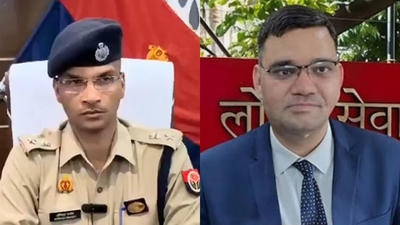
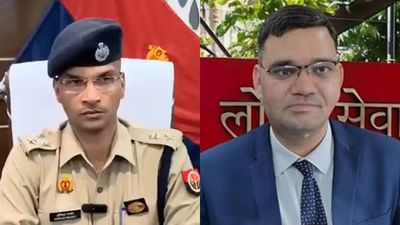
LUCKNOW: Two senior Uttar Pradesh officers used their Independence Day addresses to reflect on public service and accountability, with one invoking revolutionary Bhagat Singh to highlight delays in justice and another citing an episode from Gautama Buddha‘s life to explain the police’s use of force for maintaining peace.Rinkoo Singh Rahee (44), sub-divisional magistrate (judicial), Orai, made a provocative reference to Bhagat Singh while contrasting his sacrifices with contemporary priorities.“If we look at it properly and compare it with today’s times, it seems to me that Bhagat Singh was the most foolish. He was a useless child. He was a rebel against his own family,” said Rahee, a 2023-batch IAS officer from Aligarh district.His remarks sought to underline Bhagat Singh’s willingness to rebel against convention and put a larger cause ahead of personal and family considerations.Rahee then referred to a case pending for around three decades that recently came before his court. “Yesterday, a case came before my court. It is a 30-year-old case. I felt ashamed yesterday,” he said, questioning whether such delays were consistent with the ideals for which freedom fighters had sacrificed themselves.In Meerut, senior superintendent of police Avinash Pandey (38) used his Independence Day address at the Quarter Guard to ask personnel to reflect on the meaning of their oath and responsibilities.“We have just taken an oath that I will not resort to violence. But the police force, army and paramilitary forces are permitted to use weapons to maintain the unity and integrity of a nation. So, did we take a false oath?” asked Pandey, a 2015-batch IPS officer who hails from Kheri district.Pandey narrated an episode involving Prince Siddhartha, before he became Gautama Buddha, in which Siddhartha hid a swan wounded by a hunter and misdirected the hunter to save the bird.“If we look at it in a very narrow way, it was a lie. But if we look at it in a wider context, a lie told to save someone’s life was not a lie,” Pandey said.Drawing a parallel with policing, he added: “In the same way, when the police force uses its weapons, in a broader sense, it is done to bring about peace.”Pandey said the authority given to police personnel also increased their accountability. “The more power someone is given, the greater his responsibility becomes,” he said, echoing the famous Spider-Man maxim associated with Peter Parker’s Uncle Ben: “With great power comes great responsibility.”Warning against attempts to create divisions on the basis of caste, religion and language, Pandey said police personnel had a special responsibility because they had taken an oath and were entrusted with enforcing the law.“We have to recognise what we are in the police for. Are we here only to collect our salary and go home, or are we here to fulfil our duty?” Pandey said, adding that duty and responsibility had a meaning far beyond everyday concerns.