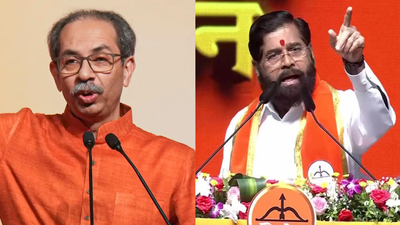
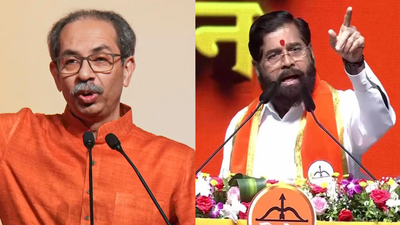
NEW DELHI: The Supreme Court on Thursday observed that the constitution of the previously undivided Shiv Sena had undergone a “significant transformation” over the years and eventually became “virtually a one-party structure.“A bench comprising Chief Justice of India Surya Kant and Justices Joymalya Bagchi and V Mohana made the remark while hearing the Uddhav Thackeray faction’s challenge to the Election Commission’s decision recognising the Eknath Shinde-led faction as the “real Shiv Sena.”“Originally, the party constitution was founded on democratic principles. Subsequently, it was amended and became virtually a one-person structure,” PTI quoted CJI Kant as observing.Senior advocate Kapil Sibal, appearing for the Uddhav Thackeray faction, countered that the Election Commission had “no authority” to scrutinise the validity or democratic character of a political party’s constitution while adjudicating a symbol dispute.In response, the CJI said that the debate goes beyond the Commission’s jurisdiction and touched upon the larger constitutional expectation of democratic functioning within political parties.“When we speak of democratic principles and institutions safeguarding democratic values, the question naturally arises whether a political party is itself expected to function democratically,” he added.Sibal agreed that political parties should ideally function democratically but argued that they cannot be equated with constitutional authorities.“But there is a distinction. Constitutional institutions perform constitutional functions, whereas political parties perform political functions. The standard of institutional integrity is necessarily much higher when a constitutional authority exercises its powers. A political decision can always be corrected. But a decision of the Election Commission, once taken in these circumstances, often cannot practically be undone,” he argued.
Share your thoughts in the comments
Be respectful · TOI community guidelines
The hearing will continue on August 11.The Shiv Sena was founded in June 1966 by Bal Thackeray. After his death in November 2012, his son Uddhav Thackeray took over as party chief. The Shiv Sena split in June 2022, with one faction led by Uddhav Thackeray and the other by Eknath Shinde after the latter’s rebellion.Following the split, Shinde approached the Election Commission, seeking recognition as the “real” Shiv Sena and claiming the party’s name and its iconic bow and arrow symbol. In February 2023, the poll panel recognised his faction as the “real” Shiv Sena, a decision challenged by the Uddhav camp in the Supreme Court.In deciding the dispute, the Commission primarily relied on the numerical strength of the party’s legislators rather than giving greater weight to its organisational wing.